Medical devices place unique demands on motion systems that go beyond precision and speed. The stakes are patient safety, regulatory compliance, and clinical reliability measured in decades. A motion system that works flawlessly for 5 million cycles in an industrial setting may still require design modifications for medical use — where biological compatibility, contamination control, and failure mode analysis add layers of engineering requirement.
Linear shaft motors meet these demands through their fundamental design: contactless force generation without lubricants, no particle generation from mechanical wear, and force control accuracy that enables sensitive force-controlled procedures. They are used across an expanding range of medical device applications from robotic surgery to drug delivery to laboratory automation.
Why Medical Devices Demand Ironless Direct Drive
The medical device application environment creates specific requirements that direct drive motors uniquely satisfy:
No lubrication contamination — Sterilizable instruments, devices used near body fluids, and cleanroom-manufactured implantables cannot use greased or oiled mechanical drives. Ball screws, leadscrews, and lubricated guides are incompatible with sterile environments. Linear shaft motors operate without lubrication entirely.
Zero particle generation — Devices used in surgical environments, cleanroom assembly of implantables, and pharmaceutical manufacturing cannot generate particles. Mechanical wear generates particles; contactless direct drive generates none.
Force control accuracy — Medical procedures often require force-controlled motion — needle insertion at controlled force, tissue manipulation at controlled tension, fluid dispensing at controlled pressure. Linear shaft motors provide force output proportional to current with high accuracy and no cogging disturbance.
Sterilization compatibility — Many medical instruments undergo autoclave sterilization (134°C steam). Motors in sterilized instruments must survive repeated thermal cycles. Linear shaft motors, with no lubricants to degrade, are inherently more sterilization-compatible than lubricated alternatives.
Long service life — Medical capital equipment (MRI machines, CT scanners, radiation therapy systems) must operate reliably for 10-15 years. No-wear direct drive maintains specification indefinitely; ball screws degrade and require replacement.
Robotic Surgery and Surgical Systems
Minimally invasive robotic surgery systems are perhaps the most demanding motion control environment in medicine — they require simultaneous precision, force transparency, and absolute reliability in a patient-contact device.
Instrument axis control — The robotic arms that hold and articulate surgical instruments require smooth, precise motion that the surgeon controls through a master console. Any cogging force or mechanical transmission nonlinearity would be felt by the surgeon through haptic feedback — degrading their ability to feel tissue resistance and perform fine manipulation.
Force sensing and feedback — Advanced surgical robots incorporate force sensing to provide the surgeon with tactile feedback that laparoscopic instruments inherently lack. Linear shaft motors' clean force-current relationship means current commands accurately predict force output, enabling accurate force feedback display to the surgeon.
Tremor filtration — Surgical robots filter out the natural hand tremor (5-10 Hz, 0.1-1mm amplitude) that surgeons cannot control. This filtering requires high-bandwidth motion control — the motor must respond quickly and accurately to motion commands from the controller. Linear shaft motors' zero cogging and direct drive enable the bandwidth required for effective tremor filtration.
Emergency stop and fail-safe — Surgical robots must stop instantaneously on command and must never move unexpectedly. Linear shaft motors hold position precisely when powered and can be designed with passive braking for power-loss safety.
Diagnostic Imaging Equipment
Medical imaging equipment generates diagnostic images from which clinicians make treatment decisions. Motion system quality directly affects image quality and diagnostic accuracy.
CT scanner gantry — Modern CT scanners rotate the X-ray source and detector around the patient at up to 3 rotations per second while translating along the patient axis. The translation drive requires smooth, precise motion — velocity variations create artifacts in reconstructed images. Linear shaft motors on CT table drives provide the smooth, controlled motion required.
PET scanner bed positioning — PET scanners step the patient through the detector ring in precise increments. Positioning accuracy determines alignment between scan positions, affecting image reconstruction accuracy. Linear shaft motors provide repeatable positioning with no backlash or mechanical compliance.
Radiation therapy positioning — Linear accelerator (LINAC) systems and proton therapy systems must position the radiation beam delivery system around the patient with sub-millimeter accuracy. The treatment plan specifies exact beam angles and positions; the mechanical positioning system must reproduce these positions accurately enough for safe, effective treatment.
Ultrasound probe positioning — Automated ultrasound systems for screening and biopsy guidance use motorized probe carriers to scan the transducer across the body surface. Smooth, controlled motion ensures uniform image quality across the scan field.
Drug Delivery and Infusion Systems
Precision drug delivery requires motion systems that can control volumetric flow rate with high accuracy over a wide range — from massive bolus doses to micro-infusions measured in nanoliters per hour.
Infusion pumps — Syringe pumps and volumetric infusion pumps use linear actuators to drive syringe plungers or peristaltic pump mechanisms. Flow rate accuracy requires consistent drive force and velocity. Cogging force from conventional motors creates pressure pulses in the delivered fluid — potentially problematic for sensitive infusions. Linear shaft motors' zero cogging delivers smooth, pulsation-free infusion.
Drug dispensing robots — Pharmacy automation systems that dispense solid and liquid medications use linear shaft motors for precise volumetric dispensing. Accurate dispensing requires controlled, repeatable actuator motion.
Implantable drug delivery — Some implantable drug delivery devices use miniature linear actuators to deliver drug doses on schedule. The combination of biocompatibility, low power consumption, and long service life (measured in years of implanted operation) makes linear direct drive attractive for advanced implantable systems.
Dialysis machines — Hemodialysis machines control blood flow rates with precision to maintain proper filtration while preventing hemolysis. The blood pump drive requires smooth force application to minimize shear forces on blood cells.
Laboratory Automation and Life Science Equipment
Laboratory automation systems process thousands of samples per day in clinical labs, pharmaceutical research, and genomics facilities. These systems require precise motion for liquid handling, sample transport, and analytical positioning.
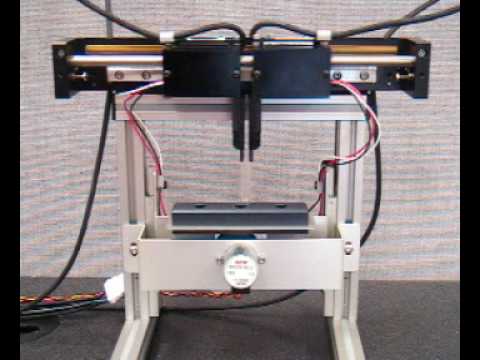
Liquid handling robots — Automated pipetting systems aspirate and dispense precise volumes of liquid for assay preparation, drug screening, and diagnostic testing. The pipette axis requires controlled, smooth motion to prevent aspiration errors and droplet formation. Linear shaft motors — as demonstrated in the pipette dispensing demo — provide the smooth force control required for accurate liquid handling.
Sample processing automation — High-throughput screening systems process thousands of compounds per day, with robotic arms moving sample plates between stations. The smooth, repeatable motion of linear shaft motors prevents liquid spillage and positioning errors that could contaminate results.
Sequencing instruments — DNA and RNA sequencing instruments use precision stages to move flow cells or imaging objectives during sequencing runs. Positioning accuracy determines sequence read accuracy. Any positioning error can cause base misidentification.
Flow cytometry — Cell analysis instruments require precise fluidic control and positioning. The laser interrogation point must be precisely aligned with the sample stream. Linear shaft motors provide the positioning stability required for accurate cell characterization.
Medical Device Design Considerations
Designing linear shaft motors into medical devices requires attention to several factors beyond the standard engineering specifications:
Biocompatibility — Materials exposed to patients or biological samples must meet ISO 10993 biocompatibility requirements. Motor materials (housing, shaft, seals) must be evaluated and certified for the intended use environment.
Sterilization compatibility — The sterilization method (autoclave, EtO gas, gamma irradiation, hydrogen peroxide plasma) affects material selection. Each method imposes different temperature, chemical, and radiation dose requirements.
EMI/EMC compliance — Medical electrical equipment must meet IEC 60601-1-2 electromagnetic compatibility requirements. Motor drive electronics must not radiate interference that could affect the device's own sensing systems or other medical devices in the environment.
Failure mode analysis — Medical device FMEAs must analyze motor failure modes and their patient safety impact. Linear shaft motors' failure modes (open circuit, short circuit) are well-characterized and generally safe. The absence of mechanical wear eliminates a class of progressive failure modes present in mechanical drives.
Regulatory submission — FDA submissions and CE marking documentation must include motion system specifications, validation data, and risk analysis. Linear shaft motors' published specifications and well-established reliability data support regulatory submissions.
Conclusion
Medical devices increasingly rely on linear shaft motors to deliver the combination of precision, reliability, cleanliness, and force control that patient care requires. From robotic surgery to drug delivery to laboratory automation, the zero-cogging, zero-wear, no-lubrication design of linear shaft motors enables medical devices that perform their functions safely and reliably over years of demanding clinical use.
Nippon Pulse America has supplied linear shaft motors for medical device applications for decades and understands the unique requirements of medical design. Our engineering team can support your design from initial concept through regulatory submission, providing the documentation and performance data that medical device development requires.