Any engineer evaluating linear shaft motors deserves an honest answer about their limitations. Marketing materials naturally emphasize advantages, but good engineering decisions require understanding the full picture — including where a technology falls short.
Linear shaft motors are exceptional for the right applications. They are a poor choice for others. This article covers the genuine disadvantages of linear shaft motors, the specific scenarios where alternatives are more appropriate, and the workarounds that address some — but not all — of their limitations.
Disadvantage 1: Higher Upfront Cost
This is the most frequently cited disadvantage, and it's real. A linear shaft motor system costs 3-10x more than an equivalent ball screw system at purchase.
A ball screw assembly for a typical automation axis might cost $300-$1,500. The equivalent linear shaft motor, with servo drive, encoder, and linear guide, might cost $3,000-$12,000. That's a significant capital difference that matters in budget-constrained projects.
When this disadvantage is decisive:
Prototypes, short-run machines, low-utilization equipment, or applications where precision requirements don't justify direct drive. If you need a motor that moves a part 100 times per day with 50 µm precision, a ball screw is the economical choice.
When this disadvantage is less important:
High-utilization production equipment where maintenance costs accumulate rapidly, applications requiring guaranteed uptime, and any application where a single unplanned outage costs more than the motor price differential.
Disadvantage 2: Requires External Linear Guidance
Unlike a ball screw — which provides its own radial constraint through the nut and screw geometry — a linear shaft motor produces only axial force. It has no inherent radial stiffness. This means an external linear guide system (rail and carriage, air bearing, or hydrostatic bearing) is required for every application.
This adds cost, space, and mechanical complexity. The linear guide must be selected, sized, aligned, and maintained. For small strokes in confined spaces, integrating a motor and guide system can be a meaningful design challenge.
Practical implications:
- System design must account for the guide system's contribution to overall size
- Guide alignment is critical for optimal motor performance
- Linear guide clearances affect overall positioning accuracy
- For very small strokes (<5mm), integrated piezo or voice coil systems may be more compact
The workaround:
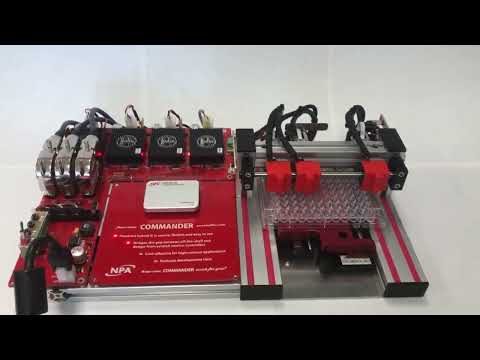
Nippon Pulse America offers integrated linear stage assemblies (SLP-series) that combine motor, precision linear guide, and encoder in a single pre-aligned package. These integrated stages eliminate the need to separately source and align components for many applications.
Disadvantage 3: Requires a Precision Linear Encoder
Linear shaft motors are inherently open-loop unstable — without position feedback, the forcer has no knowledge of its position and the servo loop cannot function. A precision linear encoder is not optional; it is a required system component.
This adds cost ($200-$2,000+ depending on resolution) and integration complexity. The encoder scale must be mounted precisely parallel to the motor axis, and encoder read-head alignment must be maintained within tight tolerances. Vibration, thermal expansion, and contamination can all affect encoder performance.
For some low-precision applications where a stepper motor in open loop would be acceptable, the encoder requirement makes linear shaft motors disproportionately complex and expensive.
Resolution requirements:
For sub-micron positioning, you need a linear encoder with at least 0.1 µm resolution. Heidenhain, Renishaw, and Numerik Jena make encoders at this resolution level, but they add meaningful cost to the system.
Disadvantage 4: Lower Force Density Than Iron-Core Motors
The ironless cylindrical design that eliminates cogging force also limits magnetic flux density. Iron-core linear motors can achieve magnetic flux densities of 0.8-1.2 Tesla in the air gap compared to 0.3-0.5 Tesla for ironless designs. All else equal, iron-core motors generate more force per unit volume.
For applications requiring very high force in a compact package — pressing, clamping, heavy workpiece handling — an iron-core linear motor or hydraulic actuator may provide better force density at lower cost.
The cylindrical advantage partially compensates:
The 360° electromagnetic interaction of the cylindrical design recovers some of the force density difference. For a given motor length, linear shaft motors often match or exceed flat ironless linear motors. But they will not match iron-core designs for peak force density.
Practical force ranges:
Linear shaft motors are well-suited for continuous force requirements from 5N to 500N. For applications requiring continuous forces above 1000N, other technologies may be more appropriate.
Disadvantage 5: Cannot Self-Support Gravity Loads Without Power
Unlike ball screws (which are back-drive-resistant) or pneumatic cylinders (which can hold position without power), a linear shaft motor has no holding force when unpowered. In vertical axis applications, the load will fall freely if power is removed.
This requires additional safety engineering:
- Mechanical brakes that engage on power loss
- Counterweights to balance the vertical load
- Hold-current modes that apply constant current to maintain position (generating heat continuously)
- Secondary locking mechanisms for safety-critical applications
Each of these adds cost and complexity. For vertical axes carrying significant loads, this is a meaningful design constraint that must be addressed from the start of the design process.
Disadvantage 6: Heat Generation in the Forcer
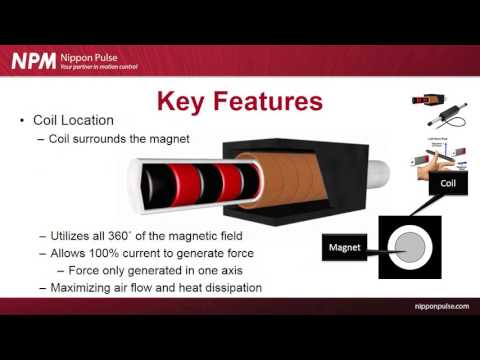
The forcer is a copper coil assembly, and copper resistance means heat generation proportional to the square of current. All the motor's electrical losses are concentrated in the moving forcer — which makes cooling it challenging.
Unlike stationary motor windings that can be water-cooled from a fixed manifold, the forcer must be cooled while moving. Options include:
- Passive convection cooling (simplest, but limits continuous force)
- Conduction cooling through the payload and carriage to a stationary heat sink
- Liquid cooling through flexible hoses routed to the moving forcer (most effective, adds complexity)
For high-duty-cycle applications or large forcers, thermal management of the forcer is a significant engineering task. The cylindrical design's 50% efficiency advantage helps — less power wasted as heat — but doesn't eliminate the challenge.
When to Choose an Alternative Instead
Given these disadvantages, here are the specific scenarios where we recommend other technologies:
- Budget < $2,000 per axis and precision > 10 µm → Ball screw
- Stroke < 5mm and maximum compactness needed → Voice coil or piezo actuator
- Force > 1000N continuous → Iron-core linear motor or hydraulic
- Prototype with < 1 year service life → Ball screw or belt drive
- Open-loop stepper application with modest precision → Stepper motor with leadscrew
- Simple on/off positioning → Pneumatic cylinder
Conclusion
Linear shaft motors are not the right answer for every linear motion application. Higher purchase cost, the requirement for external guides and encoders, limited force density, and vertical-axis safety requirements are genuine engineering constraints that must be considered honestly.
But for the applications where direct drive is appropriate — high precision, high speed, high duty cycle, cleanroom or vacuum operation, or long service life requirements — these disadvantages are typically outweighed by the performance advantages. The key is making the decision on the full set of requirements, not just upfront cost.
Nippon Pulse America's engineering team is happy to provide an honest assessment of whether linear shaft motors are the right fit for your specific application — including recommending alternatives when they are more appropriate.