Voice coil actuators and linear shaft motors share a fundamental characteristic: both are ironless, direct-drive linear technologies with zero cogging force. Engineers evaluating precision linear motion often face a choice between them for short-stroke, high-precision applications.
The choice depends on stroke length, force requirements, duty cycle, and whether position accuracy or force accuracy is the primary requirement. This article compares both technologies honestly to help engineers make the right selection.
How Voice Coil Actuators Work
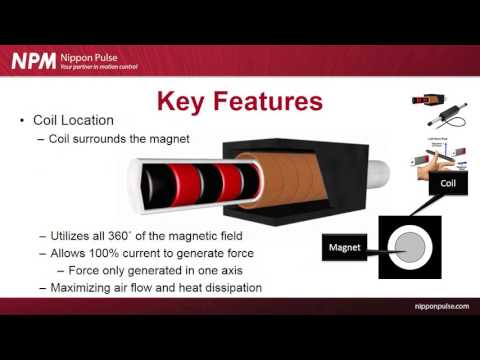
A voice coil actuator (VCA) — named for its similarity to the coil in a loudspeaker — consists of a cylindrical coil that moves within a radial permanent magnet field. Current through the coil creates a Lorentz force that pushes or pulls the coil axially.
Key characteristics of voice coil actuators:
- Simple, single-axis design — Coil, magnets, and housing in a compact package
- Ironless coil — Zero cogging, same as linear shaft motors
- Short stroke — Typically 5mm to 50mm maximum
- High force density for small packages — Compact, dense magnetic circuits
- Bidirectional force control — Push and pull from a single winding
- No internal position sensing — Requires external encoder for position control
Voice coil actuators are commonly used in hard disk drive head positioning, autofocus mechanisms in cameras, small valve actuators, and haptic feedback systems.
How Linear Shaft Motors Work (for Comparison)
Linear shaft motors use a different architecture: a cylindrical permanent magnet shaft that slides through a multi-phase coil assembly. The three-phase commutation enables the forcer to travel arbitrary distances along the shaft — not just within the magnetic field of a fixed housing.
Key characteristics that differ from voice coil actuators:
- Unlimited stroke — The shaft can be any length; stroke is only limited by shaft length
- Three-phase commutation — Requires a servo drive with commutation; more complex than VCA drive electronics
- Higher force for larger sizes — Scales effectively to larger force requirements
- Higher continuous force rating — Better thermal management for sustained force output
Head-to-Head Comparison
| Parameter | Voice Coil Actuator | Linear Shaft Motor |
|---|---|---|
| Typical stroke range | 5 – 50 mm | 10 mm – 3+ meters |
| Cogging force | Zero | Zero |
| Drive complexity | Simple (single-phase) | Complex (three-phase, commutation) |
| Force control | Excellent (I proportional to F) | Excellent |
| Peak force density | High (for size) | High (scales with size) |
| Continuous force | Limited (thermal) | Higher (better thermal management) |
| Position repeatability | Sub-micron (with encoder) | Sub-micron (with encoder) |
| Cost (small sizes) | Lower | Higher |
| Cost (large sizes/long stroke) | Not applicable | Scales linearly |
| Typical applications | Short stroke, force control, haptics | Any stroke, position control, high speed |
When to Choose a Voice Coil Actuator
Choose a voice coil actuator when:
- Stroke is less than 25mm — VCAs are optimized for short strokes and are more compact and less expensive than linear shaft motors for small strokes
- Force control is the primary requirement — VCA's single-phase design makes current-to-force relationship extremely linear and easy to control
- Simplest possible drive electronics — A VCA can be driven with a simple linear amplifier or H-bridge; no commutation required
- Highest compactness for small size — For a 10N force at 10mm stroke, a VCA will be significantly smaller and lighter than a linear shaft motor
- Haptic feedback or active vibration control — VCAs excel at high-frequency force generation for haptics, vibration isolation, and dynamic force control
- Budget is constrained for a small actuator — Small VCAs are available for $50-$200; equivalent linear shaft motor systems cost significantly more
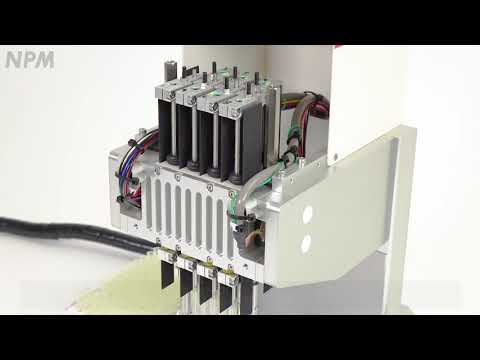
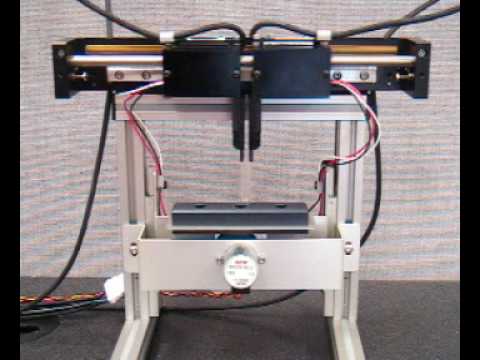
Common VCA applications: autofocus actuators in cameras and endoscopes, force-controlled grippers for delicate assembly, active vibration isolation platforms, fast tool servos for diamond turning, and needle positioning in medical devices.
When to Choose a Linear Shaft Motor
Choose a linear shaft motor when:
- Stroke exceeds 50mm — VCAs are physically impractical for longer strokes; linear shaft motors scale indefinitely
- High speed is required — VCAs have inherent velocity limitations due to back-EMF in their short strokes; linear shaft motors reach 5+ m/s
- High duty cycle is needed — Linear shaft motors have better continuous force ratings due to superior thermal management of the cylindrical design
- Multi-axis coordinated motion — Linear shaft motors integrate naturally with servo systems controlling multiple axes simultaneously
- Long service life in production — Both are zero-wear, but linear shaft motor systems are more mature in production machine applications
- Position control over a range — For applications requiring precise positioning to multiple targets over a significant stroke, linear shaft motors are the correct choice
The Gray Zone: 10-50mm Stroke
For strokes in the 10-50mm range, both technologies are viable and the choice depends on secondary requirements:
- If force control and simplicity are paramount → Voice Coil Actuator
- If position accuracy and speed are paramount → Linear Shaft Motor
- If cost is the driver and force is modest → Voice Coil Actuator
- If the system will grow in stroke or force → Linear Shaft Motor (more scalable)
In medical device applications — particularly needle insertion, syringe drives, and endoscopic tools — voice coils often win for short strokes. In semiconductor and precision automation, linear shaft motors dominate where strokes exceed 25mm.
Conclusion
Voice coil actuators and linear shaft motors are complementary technologies, not direct competitors. VCAs own the short-stroke, simple-drive, force-control niche. Linear shaft motors own the longer-stroke, higher-speed, multi-target positioning niche.
The overlap in the 10-50mm range requires careful analysis of your specific force, speed, duty cycle, and budget requirements. Nippon Pulse America manufactures both linear shaft motors and integrated linear stages and can help you determine which technology is the right fit for your application requirements.