The fundamental choice in linear motion system design is between direct drive — where the motor produces linear force directly — and indirect drive — where a rotary motor converts its output to linear motion through a mechanical transmission.
This choice has profound consequences for system precision, speed, reliability, and total cost. Understanding the engineering tradeoffs between direct and indirect drive helps engineers make the right decision for each application — and understand why direct drive has become the dominant technology for high-performance linear motion.
The Indirect Drive Penalty: Every Mechanical Element Adds Error
Indirect drive systems — ball screws, lead screws, timing belts, rack and pinion, chain drives — all convert rotary motion to linear motion through mechanical elements. Each element in the chain introduces errors, losses, and potential failure modes.
Ball screw systems — The most common indirect drive for precision applications. A ball screw converts rotary motion through the interaction of recirculating balls in the screw and nut. Error sources include:
- Lead error — Manufacturing variation in screw pitch (typically 3-50 µm/300mm for precision screws)
- Backlash — Gap between ball and screw at direction reversal (0 with preloaded nut, but preload increases friction and heat)
- Thermal expansion — Screw heats under load; 1°C rise × screw length × thermal coefficient = positioning error
- Resonance — The screw is a mechanical oscillator; first natural frequency limits maximum speed and acceleration
- Wear — Balls wear against screw; precision degrades with use
Timing belt drives — Lower cost than ball screws, but with significant compliance, belt stretch under load, and long-term creep. Suitable for applications requiring ±0.5mm accuracy; unusable for precision positioning.
Rack and pinion — For long strokes where ball screws are impractical. Backlash is inherent and significant without expensive anti-backlash mechanisms. Suitable for large-envelope, moderate-precision applications.
The Direct Drive Advantage: Eliminating the Error Chain
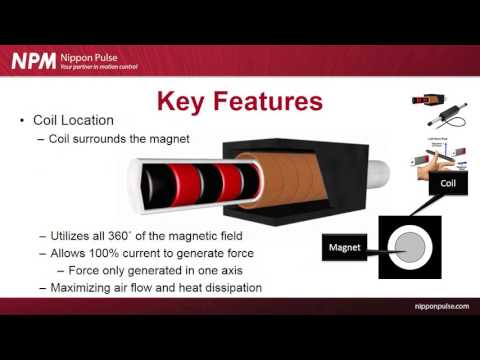
A linear shaft motor directly converts current into force, with no intermediate mechanical elements. The only elements in the error chain are the motor itself and the encoder.
Motor errors (minimal):
- Force constant variation with temperature (typically <0.5% per °C) — compensated by servo loop
- End-of-travel cogging (when forcer reaches shaft end) — avoided by design
No errors from:
- No backlash (no mechanical transmission)
- No lead error (no screw)
- No screw thermal growth
- No resonance from mechanical coupling
- No wear effects on positioning accuracy
The servo loop closes around the encoder, which measures the actual position of the load directly. Any positioning error — from any source — is corrected by the servo. This is fundamentally different from indirect drive, where the encoder typically measures the motor rotation, not the load position. Any error between motor and load (compliance, backlash) is outside the servo loop and cannot be corrected.
Precision Comparison: Numbers Tell the Story
| Metric | Ball Screw (precision grade) | Timing Belt | Rack & Pinion | Linear Shaft Motor |
|---|---|---|---|---|
| Positioning accuracy | 1-5 µm | 50-200 µm | 20-100 µm | <1 µm |
| Repeatability | 0.5-2 µm | 20-50 µm | 10-30 µm | <0.1 µm |
| Backlash | 0-5 µm (preloaded) | 50-200 µm | 50-500 µm | Zero |
| Velocity smoothness | Good (cogging from servo motor) | Poor (belt compliance) | Moderate (tooth engagement) | Excellent (zero cogging) |
| Max speed (typical) | 0.5-1.5 m/s | 3-5 m/s | 2-5 m/s | 3-10+ m/s |
| Max acceleration | Limited by screw resonance | Limited by belt stretch | Moderate | Very high |
Speed and Dynamic Response
Indirect drive systems have inherent speed limitations from mechanical resonance and inertia:
Ball screw critical speed — A ball screw shaft is a mechanical oscillator. As rotational speed increases, it approaches its first natural frequency — the "critical speed." Above approximately 70% of critical speed, vibration makes operation unsafe. For a 1-meter screw, critical speed limits linear motion to roughly 0.8-1.2 m/s for common screw diameters. Longer screws have lower critical speeds.
Belt resonance — Timing belts have compliance and mass. At certain speeds, the belt resonates, causing velocity ripple and potential failure. Tensioning and belt selection affect this, but it remains an inherent limitation.
Inertia mismatch — Indirect drive systems have reflected inertia from the motor, coupling, and screw that must be controlled by the servo. High inertia ratios limit servo bandwidth and dynamic response.
Linear shaft motors have none of these limitations. The forcer is directly connected to the load, with no mechanical resonances between them. Maximum speed is limited only by the back-EMF constant and available supply voltage — typically achievable at 5+ m/s for most motors.
Reliability and Maintenance Over Time
This is where direct drive demonstrates its most compelling economic advantage over indirect drive.
Ball screw wear cycle:
Ball screws wear progressively with use. As balls wear against the screw raceway, the recirculating ball geometry changes, increasing friction and backlash. In precision machines, screws are typically replaced every 3-5 years in production environments. Each replacement requires machine downtime, realignment, and recommissioning — easily $2,000-$10,000 in direct costs, plus production losses during downtime.
Linear shaft motor wear cycle:
The forcer coils do not contact the shaft. There is no mechanical wear anywhere in the motor. A linear shaft motor operated within its thermal and electrical ratings will maintain its specification indefinitely. The only maintenance item is the external linear guide bearing — which can be selected for very long service life with proper lubrication.
MTBF comparison (production machine, 16hr/day):
- Ball screw: 2-4 year replacement cycle
- Timing belt: 1-3 year replacement cycle
- Linear shaft motor: No wear-related maintenance required
When Indirect Drive Is the Better Choice
Honest engineering analysis acknowledges that indirect drive is sometimes the correct choice:
- Very high force at low speed — Ball screws can generate thousands of Newtons from a small servo motor through mechanical advantage. For clamping, pressing, or cutting at high force and low speed, ball screws often provide better force density per dollar.
- Long stroke at moderate precision — For 3-5+ meter strokes with ±50 µm accuracy, rack and pinion is cost-effective. Linear shaft motor shafts at this length are expensive and require shaft support.
- Budget-constrained projects — The 3-10x cost premium of direct drive is not justifiable for all applications. If the machine runs 1 shift per day and precision requirements are modest, ball screws offer acceptable performance at lower cost.
- Holding loads against gravity — Ball screws are naturally back-drive-resistant; they hold position without power. Linear shaft motors require brakes or constant current for vertical axis holding.
Conclusion
Direct drive removes every mechanical element between motor and load — and with each element removed, a source of error, wear, loss, and maintenance disappears. For precision, speed, and long-term reliability, the engineering case for direct drive is clear and well-proven across decades of application in semiconductor, medical, and advanced automation equipment.
The cost premium of direct drive is real. The question is whether that premium is justified by your application's precision, speed, duty cycle, and reliability requirements. For an honest answer specific to your application, contact Nippon Pulse America's engineering team.