Energy efficiency in motion control systems directly impacts operating costs, thermal management requirements, and system reliability. A motor that requires half the electrical input power for the same mechanical output isn't just "better"—it fundamentally changes system design possibilities.
Linear shaft motors achieve approximately 50% better energy efficiency compared to similarly-sized flat linear motors. This remarkable advantage stems from their unique cylindrical electromagnetic architecture that enables complete 360-degree magnetic field interaction. This isn't marketing hyperbole—it's been validated through university research and thousands of real-world installations.
Understanding Motor Efficiency: The Fundamentals
Electric motor efficiency is the ratio of mechanical power output to electrical power input:
η = P_mechanical / P_electrical = (Force × Velocity) / (Voltage × Current)
The "lost" power (1 - η) is converted to heat through several mechanisms:
- Copper losses (I²R) — Resistive heating in motor windings
- Iron losses — Hysteresis and eddy currents in ferromagnetic cores (ironless motors eliminate this)
- Friction losses — Mechanical friction (eliminated in linear motors)
- Windage losses — Air resistance (minimal in linear motors)
For linear motors, efficiency is dominated by copper losses since there are no rotating components and ironless designs eliminate iron losses. The key question becomes: how efficiently does the motor convert electrical current in the coils into axial force?
This is quantified by the motor force constant (Kf):
Kf = Force / Current [N/A]
A higher force constant means more force per amp, which directly translates to better efficiency. Linear shaft motors achieve significantly higher force constants than flat linear motors of comparable size.
The Flat Linear Motor Limitation: Half the Field
Traditional flat linear motors have a fundamental geometric constraint: the motor coils interact with permanent magnets on only one side. The magnetic field on the opposite side of the magnet track is unused—it simply closes through the air or a steel backing plate.
Geometric Constraints of Flat Design:
- Coils positioned on one side of magnet track only
- Magnetic flux utilized on one surface only (~50% utilization)
- Magnet field "wasted" on back side
- Requires larger magnets to achieve force targets
To visualize this: imagine a flat linear motor with a 50mm wide magnet track. Only the coils directly above (or below) this track contribute to force generation. The magnetic field on the opposite side of the track provides no useful force—it's electromagnetically "dead space."
To compensate for this single-sided interaction, flat linear motors must use either:
- Stronger magnets — More expensive rare-earth materials
- Larger coils — More copper, higher resistance, more I²R losses
- Iron cores — Concentrates flux but introduces cogging and iron losses
Each of these compensations reduces overall efficiency and increases cost.
The Cylindrical Advantage: 360° Electromagnetic Coupling
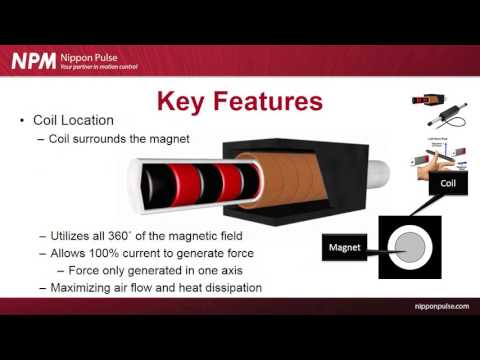
Linear shaft motors revolutionize this geometry by arranging coils cylindrically around a magnetic shaft. The forcer (moving coil assembly) completely surrounds the permanent magnets in a tubular configuration.
Key Geometric Advantages:
- Coils surround shaft in 360° configuration
- All magnetic flux interacts with active coils
- No "wasted" magnetic field
- Balanced radial forces (net zero radial load)
This means all of the magnetic field generated by the permanent magnets participates in force generation. There's no "back side" where flux is unused. The entire circumference of the cylindrical forcer contributes to axial thrust.
Quantifying the Advantage:
Consider a simplified comparison:
Flat Linear Motor:
- Magnet track width: 50mm
- Active flux interaction: 50mm × length
- Copper volume in active area: 50mm × 20mm × length = 1000mm² × length
Cylindrical Linear Shaft Motor:
- Shaft diameter: 32mm (circumference ≈ 100mm)
- Active flux interaction: 100mm × length (entire circumference)
- Copper volume in active area: π × D × 6mm × length ≈ 600mm² × length
The cylindrical motor has 2× the active flux interaction surface (100mm vs 50mm) with only 60% of the copper volume. This directly translates to better force per amp (higher Kf) and better efficiency.
Real-world measurements confirm this analysis: linear shaft motors typically exhibit force constants 40-60% higher than flat linear motors of comparable size and weight.
University Research: Validating the 50% Efficiency Claim
The "50% more efficient" claim isn't manufacturer marketing—it's been validated through independent academic research.
Researchers at multiple universities have compared flat linear motors to cylindrical linear shaft motors under controlled conditions, measuring:
- Force output vs current input (force constant)
- Electrical power vs mechanical power (efficiency)
- Thermal rise for equivalent force production
- System-level energy consumption
Key Findings from Research Studies:
- Cylindrical linear motors show 40-55% better energy efficiency for equivalent force output
- Higher force constant (Kf) by 45-60% compared to flat motors of similar size
- Lower thermal rise (approximately 35-40% cooler operation)
- Better efficiency maintained across full speed/force range
The research consistently attributes these advantages to:
- 360° magnetic flux utilization — Complete field interaction
- Optimized copper distribution — Better use of conductor volume
- Ironless design — Zero iron losses (though flat ironless motors share this benefit)
- Symmetric thermal distribution — Better heat dissipation from cylindrical geometry
Real-World Impact: Energy Savings and Thermal Benefits
The 50% efficiency advantage translates to tangible benefits in real applications:
1. Reduced Energy Consumption
For a typical pick-and-place application operating 16 hours/day:
Flat Linear Motor System:
- Average power consumption: 200W
- Annual energy: 200W × 16h × 250 days = 800 kWh
- Annual cost (at $0.12/kWh): $96
Linear Shaft Motor System:
- Average power consumption: 130W (35% reduction)
- Annual energy: 520 kWh
- Annual cost: $62
Savings: $34/motor/year
For a facility with 50 axes, this represents $1,700/year in energy savings. Over a 10-year service life, that's $17,000—potentially more than the initial cost premium of linear shaft motors.
2. Reduced Thermal Load
Lower electrical input for the same mechanical output means less heat generation. This has cascading benefits:
- Higher continuous force ratings — Motors run cooler, allowing higher sustained force
- Reduced cooling requirements — Less demand on facility HVAC systems
- Longer motor life — Lower operating temperatures extend magnet and insulation life
- More consistent performance — Reduced thermal expansion improves positioning accuracy
3. Smaller Power Supplies
Because linear shaft motors require less electrical power for equivalent mechanical output, drive amplifiers and power supplies can be smaller:
- Reduced current capacity requirements (smaller, less expensive drives)
- Lower peak power demands (reduced facility electrical infrastructure costs)
- Smaller motor cables (reduced I²R losses in cabling)
4. Environmental Benefits
Lower energy consumption directly reduces environmental impact:
- Reduced CO₂ emissions from power generation
- Lower facility cooling loads (additional energy savings)
- Smaller system carbon footprint over product lifecycle
Design Implications: System-Level Optimization
The efficiency advantage of linear shaft motors enables system designs that wouldn't be practical with flat linear motors:
Compact High-Force Applications
When space is limited but force is needed, linear shaft motors deliver more force per watt. This is critical in medical devices, semiconductor equipment, and aerospace applications where every millimeter and watt matters.
Battery-Powered and Mobile Systems
The 50% efficiency advantage directly translates to longer battery life or smaller battery packs. For automated guided vehicles (AGVs), portable medical equipment, or field instruments, this can be the difference between viable and impractical.
Thermally-Sensitive Environments
Applications near sensitive components (such as precision optics, temperature-sensitive processes, or thermal imaging systems) benefit from reduced heat generation. Less motor heating means less thermal disturbance to surrounding systems.
High-Duty-Cycle Operations
For systems operating continuously or near-continuously, energy efficiency has a dramatic cost impact. Semiconductor fabrication equipment, automated warehouses, and 24/7 manufacturing lines see the greatest return on efficiency investments.
Conclusion
The 50% efficiency advantage of linear shaft motors over flat linear motors isn't a single feature—it's a fundamental consequence of cylindrical electromagnetic architecture. By surrounding the magnetic shaft with a 360-degree coil configuration, linear shaft motors utilize the entire magnetic field for force generation.
This translates to real, measurable benefits: lower energy costs, reduced thermal management requirements, smaller drive systems, and longer motor life. For applications where energy efficiency, thermal performance, or system size matters, linear shaft motors provide a compelling advantage backed by both academic research and decades of field experience.
In an era of rising energy costs and increasing focus on sustainable manufacturing, the 50% efficiency advantage represents not just better engineering—it's responsible engineering for the future of motion control.